mainSS
Tell me more about the Dodge Farm Tractor.
-
It's not the long rods that made for low end, it is the looong stroke.
There is an optimum rod length, figured in how many degrees it swings back and forth at the wrist pin. Too long, less swing, poor oiling of the wrist pin. Too short, too much swing, to much side thrust on the piston. Thats a difference in the high-block vs low block in the big blocks by both Mopar and GM.
I did have a 230 idling at 50 rpm once. Smooth as glass. Then I looked at the oil pressure- ZERO! Oil volume drops with speed, but clearances don't get any tighter!
ETA, No, I don't think the exhaust gas is any closer to the springs in a FH than in a OHV. I would think that the excess heat in the oil could be from two places: oil splased directly onto the inside of the exhaust ports in the block, and also directly from more friction involved with the looong stroke. Rings rub twice as far in a twice as long stroke, plus the greater momentum of the faster moving rod and piston weight makes more heat every stroke when the have to slow down and go back the other way. Remember, double the stroke will eqaul the same speed as double the rpm. Plus, double the speed will make FOUR times the heat.Leave a comment:
-
Chris-
A father-son team down in Tennesse were campaigning an antique tractor made by Dodge during the 50's from 2-ton truck parts. They quickly learned that the 230 didn't last long at 5-6000 rpm, and the biggest problem was the oil feed to #2 & #3 crank mains. These supply oil to rods 2,3 and 4,5 and these would fail at high rpm's (especially 2 & 5) from oil starvation. They solved the problem by cross-drilling the holes in the crank main journal so that the holes supplying the rods were connected. You don't drill new holes in the crank, instead you drill through the existing hole so that it will exit into the other rod hole, creating a passage between them. Mains #1 and #4 supply one rod each, so it's not necessary to drill them. They also deepened and widened the grooves in the bearings, but didn't say how deep or how wide. I would be extremely cautious about messing with these grooves for 2 reasons- (1) Research by GM in the 50's showed that grooving the bottom bearing shell DOUBLED oil film pressure ( which is why GM bottom bearings aren't grooved), and (2) increasing oil flow thru the bearings without knowing how much oil volume is being supplied is tricky- guess wrong and things get ugly quick. They also mentioned that the holes in the block didn't line up well with the one in the bearing, and required matching. I'd cross-drill and match, and leave the grooves alone.
They'd rev the engine up to 5-6000 rpm off the line, and hold it for 10-15 sec under full load during a pull- on stock valve springs! They did line bore the block, balance the rotating assembly to 6000 rpm, and spent a lot of effort on rod prep. There were no problems in 2 years of competition, and several teardowns showed no unusual main/rod bearing wear. One thing they did note was how quickly the flathead heated up compared to tractors with OHV engines. After a run, the oilpan was so hot you couldn't touch it, and the rest of the engine was mighty warm also. A 292 engine oilpan would be moderately warm, but its water temp would be higher. The flathead weighs twice as much, but is hotter over all except for water temp-odd! I've noticed that oil colors faster in the PW than in my Monte's V8, so an oil cooler might be a good idea. I would guess that the heating is due to the exhaust exiting thru the block close to the valve springs, which would expose the oil to higher temps than an OHV engine.
I did find some Gross Hp vs Net Hp figures- the difference was 103 vs 91 at 3600 RPM, which would be~12%. After adding it to the tranny and rearend loss, you'd have about 32% loss, excluding t-case and tire losses.
One thing I've noticed about the 230 is that it can lug at levels that would make modern engines buck like a Texas bronco. I'm thinking this may be because of the much longer rods- I'd like to see what a modern OHV head with non-siamesed intake runners and Fast Burn combustion chambers would do for that long rod bottom end!Leave a comment:
-
Mu consciousness is steadily streaming:
How about an intake/riser/heater/collector? From one block of aluminum, three holes on the bottom to line up with the required three intake runners, one big hole on top to suit the carb, made from a block large enough to allow drilling lots of interconnecting holes for running hot water through? The three holes would make lots more surface area to conduct the heat from the riser to the air charge.
Now back to my regularly scheduled surfing....Leave a comment:
-
And oh, what were the tractor pull oiling mods?
I heard back in 77 that you could reduce the size of the oil holes in the crank, at the rods, to prevent the crank from acting like a centrifugal pump and sucking the oil out of the rest of the system. Never did try it.Leave a comment:
-
So the heat pipe is a 'theoretical' item at this point in time.
The engine in my command car was a mish-mosh of parts, rebuilt and assembled in about 1978. I know that I had three sets of valves, and still had to buy four new exhausts anyways. So CR and cam are unknowns at this point. 95 psi? seems memorable.
Max hp is the only data I remember, after 25 years. OH, and there was an intermediate test, 52 horse power with a dyno tune and a Holly 1bbl from a slant six. And paper air filter.
Re: HP ratings:
Gross horsepower is with NO accessories- like alternator, water pump, or any drive train. Reasonable drive train/water pump/alternator loss for a modern V8= 15%? Would be about 40 HP? So same drivetrain/pump/alternator loss from 95hp would equal something like 45?
That command car ran better than any of the other 5-6 PWs I've had. Maybe it was lighter, being 1/2t, and less drag, being open top, and less friction in the t/c, being one speed? But I did add an MU-5 and bumper. Plus rode better with the lighter springs. I was running M37 5.83 pumpkins, in spite of the smaller splines on the 1/2t axles. It was a lot of fun, 25 years ago. 14 folks and a keg of beer, heading to the beach. John Winn standing up behind the rear seat, peeing off the back on El Cajon Blvd. Before sun set. Ah, memories. I spent lots of my money on power wagons and beer, and wasted the rest...Leave a comment:
-
Chris;
I'm looking at the percentage difference between your starting point (45) and your endpoint (65)- that's how I came up with ~30% increase for 20 Hp. Shell Oil experimented with a heatpipe hotspot add-on device called the "Vapipe" in the 70's, but never produced it commercially. The idea was that exhaust heat works faster than water for cold starts, but has problems with carbon/corrosion in manifold passages, so the heatpipe would replace small dia exhaust crossovers in the intake manifold. In my opinion, efficiently vaporizing gasoline to uniform 10 micron particles is the way to go- you don't lose power by heating incoming air (about 1% per 10 deg F). What rpm did you run your dyno tests at? I'm puzzled by the 45 Hp figure- it just seems rather low for a 95 Hp output, unless the 95 Hp was a "gross Hp" rating. It seems that combining better breathing with more compression and a 1958 pattern head should get earlier model PW's enough power for moderate highway speeds. If the crank oiling mods used on the tractor pull 230 work for sustained 4000 rpm operation, it would also help the highway problem with the 5.83's.Leave a comment:
-
Chris, for the "masses" here is that photo I sent you regarding the Jeep 258 header, 304 Stainless, about $550.
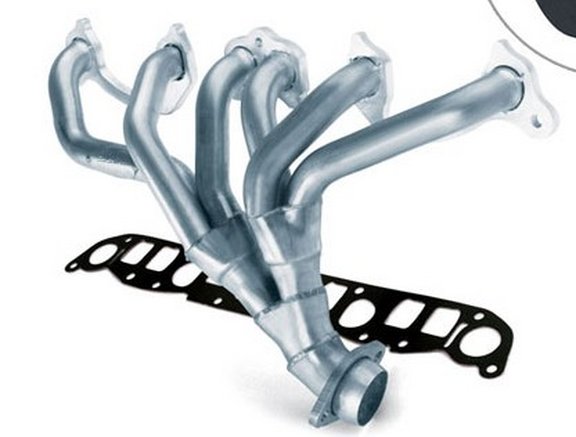
Leave a comment:
-
Harbor Freight is cheap, but they're all china crap, might last through one bend, might not.....
Look on epay for an old Greenlee conduit bender, they work great for nice clean bends and crank by hand (you can relate?)....= )Leave a comment:
-
Stainless would be nice, but Jeez! About $400 for SS parts from Classic.
I used the typical 'crush bender' for the usual exhaust pipe. Like the cheapest headers are made. Obviously, it worked well. But did get crusty in time. Any pics I would have would have been after 20 years- you boys would lose all respect for me if you saw the state they were in 20 years after I made them. I think I had sprayed them once upon a time with gold header paint. Tacky, but functional.
ETA: I probably used 1 1/2" pipe. I doubt if I found 1 3/8" locally, or that we had dies for it. Tubing is by OD, which would make 1 1/2" 16ga tube 1 3/8 ID. How little are the ports in the block?
Maybe I'll eBay a hydraulic bender and go into business? Dyno Shop payed $2500 for theirs, used, in 1982. I wonder what Harbor Freight has?
ETA: I see Harbor freight has a 12t bender for $70. Anybody try one like that on exhaust pipe? Yaknow, the vertical hydraulic jack that you hand pump. It would only need to pump up a couple dozen 90 degree bends, if you didn't screw up any pipes...Leave a comment:
-
I don't know if this has been brought up yet, but 'Classic Tube' has pre-bent piping.
After you get your pattern made you could buy their tubing and just cut and weld. It's a lot cheaper than buying a mandrel bender for one set, expensive for mass producing but since I don't see this as being a large order product, it may work for you.
Classictube.comLeave a comment:
-
20 horse power is 44% of 45hp.
That is, 65 is a 44% INCREASE over 45.
45 would be a 30% DECREASE from 65.
Funny how math works, ain't it?
Monkey, is it too late for a 'before' dyno test? It looks like I am the only one here that has ever run a flat head on a dyno. Thanks, Paul, for the fringe benefits back then. Dyno, pipe bender, Mig....
Has anybody used a 'heat pipe' on an automotive engine? Seems to me we are we getting sidetracked from manifolding with a simple water heated spacer, like many cars use. Isn't a 'heat pipe' going to need jacketing to get some surface area at each end? Fine, the high-tech vapor/condense cycle is waaaaay efficient, but the point is NOT to make the inner fluid of the heat pipe hot, but to get heat to the incoming air. Simpler with a water heated riser.Leave a comment:
-
MM;
Yes, I had the heat pipe orientation backwards- hot side is down for wickless application. The inside of the pipe has to be absolutely clean prior to the introduction of the fluid and final sealing, especially if the pipe is evacuated, as any outgassing of contaminates will block vapor transport. The working temp range is determined by the fluid's boiling point and the pressure it's under. If water is used at atmospheric pressure, the pipe starts working at 212 deg, if the pressure is increased or decreased, the working temp will change. On another note, I reviewed by % figures on Chris's intake/header dyno test, and found the increase to be~ 30.8%. The difference between 65 and 45 is 20 Hp, and dividing 20 by 65 = .30769 . As a check, 65 multiplied by .308 = 20hp which is the increase. A 44% increase would be 28.6 hp, subtracting this from 65 = 36.4, not 45. It would be interesting to see what rpm the test was run at as well as the model year of the 230, because the earlier versions were rated @ 95 hp at 3400 rpm on a 6.7:1 CR. By the mid-fifties, the CR was 7.25:1, hp was 103, and in 1958 a head design change in the valve pockets and another CR bump to 7.8:1 raised hp to 120. If Chris's 230 was 95 hp version, it would have lost 50 hp through the drivetrain at the original 45 rwhp- which is excessive. Generally quoted loss figures for mechanical trannys are 15-18%, and 5% for the rearend, or ~20-24% vs 53%. I haven't seen any figures for bias-ply tires or transfer case losses, but I doubt they'd add another 30+ percent. The increase in engine efficiency over the years would add up to a 21% increase, so it would be fun to run a chassis dyno test on your rig after intake/exhaust improvement, and see what it gains. From what I've heard, the 251 is a noticeable difference over the 230, and it was rated at 115-125 hp during its reign, so 120 hp sounds like the number to try for. Finally, a "hot spot" works better than intake air heating for vaporization, heat pipes work very quickly once their vaporization point is reached, but the best thing for power production is not to heat incoming air at all. I did some "cold vapor" experimentation on an Escort in the 80's and was able to get 60 MPG when everything worked (not often, with that system).Leave a comment:
-
tortoise
Slow works for me, not looking to make a dragster out of a 3.5 ton vehicle anyway. I just want reliable and durable (with a nice mellow throaty tone)Leave a comment:
-
Ha! The next biggest restriction is the design.....= )
I'd buy some of those living book tapes and just enjoy the slow journey.....= )Leave a comment:

Leave a comment: