
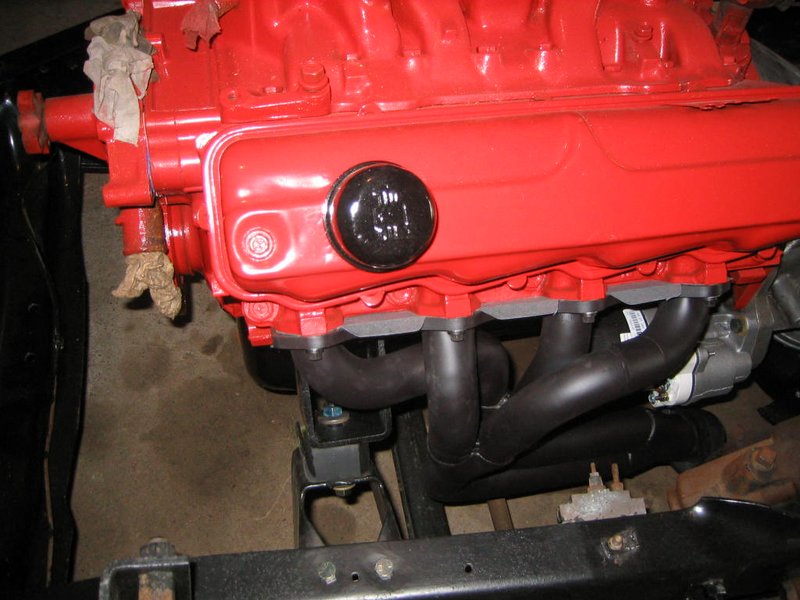
Now, THAT'S A HEADER!!!
Goes with the usual Mopar Norm outlook: DO IT RIGHT OR DON'T DO IT AT ALL!
Again, beautiful, Norm....
-
what rotten luck, oh cruel fate! How long have they been available? Maybe it's just a matter of time.......Originally posted by MoparNorm View PostLeave a comment:
-
No, it was a 2700 mile round trip, but he sent me photos every step of the way and made changes or answered questions daily, we emailed over 100 times in three months and spent a great deal of time on the phone. I also had several sets of eyes from this forum to report to me. It worked out great. Building them turned out to be the easy part...Originally posted by monkeymissile View Post
Sales have not been as expected, in fact much worse and the one Poly powered truck that they don't fit, and was the truck with the fewest vehicles still on the road, seems to have the most guys wanting headers...Murphy's Law, I'd guess...= (Leave a comment:
-
The light bulb finally turned on!
When I was asking about the two different pipes, I was thinking about civilian Power-Wagons. I forgot that your project is for your M43. Sorry about that. I am not familiar with the pipes found on those trucks. Both of the Power-Wagon pipes are 1-piece, each dimensionally unique.Originally posted by monkeymissile View Post
It sounds like you have it about all covered!Leave a comment:
-
Clint,Originally posted by Clint Dixon View Post
hey, that's a good question. I knew there were two different pipes, but wasn't aware that there were any dimensional differences. I though the later pipe was just one piece instead of the earlier two-piece. I have the one-piece.
You mean making sure one can get at the valve covers with headers installed? Nope, haven't yet modeled those in 3D. I can tell already that going to be an issue though. Another reason to do a quickie mockup with some flexible tubing.
Anything else I am missing? You're on a roll.......
Thanks-seriously!
JustinLeave a comment:
-
If you are considering using the stock 2" exhaust pipe from the header to the muffler, which one are you using? There were two different ones used depending upon which manifold was used: early or late. Not that it would be any problem for someone to switch pipes if their truck happened have the one you are not using.Originally posted by monkeymissile View Post
Also, have you considered routing the tubes for clearance so that hot valve adjustment is possible once the header is installed?Leave a comment:
-
based on readily available and affordable parts these are the two design options I consider buildable.Originally posted by maineSS View Post
I believe that Option A would be the better performing design, but harder to build.
The straight section of pipe represents the stock 2" pipe that I want to keep so it becomes a bit of a deciding factor for pipe diameters above it.
thoughts?Leave a comment:
-
I would think that with them fitting 11 trucks you'd have no problem selling them all!Originally posted by MoparNorm View Post
Did you ever go see your headers being made?Leave a comment:
-
What size were you planning to use for your intermediate primary (I assume you're thinking Tri-Y)- the one that receives input from 3 cyl and merges with the collector? Your original concept was quite close to the commercially available interference type Tri-Y's- some adjustment of that should be all that's needed.Leave a comment:
-
We ran all of the parts in lots for 50 sets. I don't have photos, those belong to the fabricator and are in his shop.Originally posted by monkeymissile View Post
We actually shipped that prototype back and forth between us, 4 times... so I could test fit the various trucks that fit the same set.....= )
They actually fit 11 different truck types, it wasn't easy...= )Leave a comment:
-
Clint,
sounds like you have some experience with the process, excellent!
Perhaps I should've been more specific. I typically call a device designed to hold a part(s) for machining or welding a jig and tooling more like punches, dies, molds and the actual cutting tools in the case of lathes and mills. At least that's what we called them where I worked. At any rate, I believe we're talking about the same thing!
I am also well down the reverse engineering road. I have a 3D CAD model started and so far modeling the block, oil+fuel pumps and intake manifold has been easy. The tricky part is modeling the actual primaries because they need to change direction so often. I am still relatively new to the world of NURBS modeling so it's been a big learing curve. I hope I don't have to switch CAD applications if mine can't hack it!
That's why I thought my flexible foam rod idea might be faster and get me to the same place in the end. It all depends; I'll have way more computer time this winter than hands-on truck time......
FEA would be sweet indeed. Oddly enough I used to work for an outfit that did FEA, but they've since gone under.Leave a comment:
-
By "jig" I assume you mean tooling?
Tooling is commonly built around an existing product in a 3D design environment. Tooling typically locates all components of the product in respect to their individual three established datums with shimability in the three respective directions. Tooling also commonly has manual, pneumatic, and/or hydraulic clamping capability. It may also have an eject system to remove the finished product from the tooling. Product can become locked in the tooling due to twisting and general movement of parts because of the introduced heat from the welding process. Well designed tooling can be adjusted to compensate for the anticipated and resulting twisting.Originally posted by MoparNorm View Post
In using computer 3D CAD software package the process of steps might be such:
1) Reverse engineer the engine block and create a 3D model
2) Reverse engineer any other peripherals that the headers must fit around and create 3D models of same
3) Design and model header components and assembly as a product
4) Combine product and peripherals together in a 3D assembly to determine design fit, style, shape, and function
5) Run FEA analysis on 3D product to determine strength, effects of welding, effects of exhaust heat, etc.
6) Create Engineering drawings of product from design
6) Build plastic, wood, paper, etc. prototype model from Engineering Drawings and test for fit on actual vehicle
7) Design tooling around 3D product to assure that each product produced is the same as the one before it and the one after it.
7) Create Engineering drawings of tooling design
8) Build tooling from Engineering drawings
9) Build product utilizing tooling
Of course, these steps and this level of effort is not necessarily needed on a project such as this, but this is a graphic representation of why we find only a limited number of Power-Wagon parts being created or reproduced.Leave a comment:
-
prototype
Norm,Originally posted by MoparNorm View Post
I hear you and if younger I'd probably jump right into this, but with limited time+resources I feel more comfortable making a pre-prototype before I start cutting tubing. Considering that I want all primaries to be the same length, but don't know what that length is yet, I was thinking that 1 1/4" foam backer rod with some 3/32" or 1/8" welding rod down the middle would make cheap and reasonable approximations of my final pipes. Then once I figure out where all 6 pipes go I can start cutting and tacking steel, building one pipe at a time and still have the other foam pipes in place to check fit.
Then I'd build my production jig once the first full set was tacked up.
Question for you since you've done this before: How did you replicate all the various lengths+cuts of pipe required for each primary when you went into production? Were all the parts numbered/cataloged and then mass produced to be welded up when needed?
Your prototype pic is great. I am considering making a simple expanding tube-end tool to make slip-fits for easier welding.
Do you have any pics of the production jig you could send me?
ThanksLeave a comment:
-
If you're going to do this seriously, you'll need to make a jig so that every set is identical and a perfect fit.
You can only make a jig from a full sized set, so you may as well bite the bullet and buy the real tubing and start test fitting your prototype set.
This is the Poly Header prototype, in a WDX:


Leave a comment:
Leave a comment: